It was an ordinary Tuesday evening — the kind that slips quietly into the blur of every other weekday. I had just finished work, my mind crowded with deadlines, bills, and the endless to-do list that never seemed to shrink.
The grocery store buzzed with its usual rhythm. Fluorescent lights hummed overhead. Shopping carts rattled across the tile floor. Barcodes beeped steadily from every checkout lane.
I was exhausted — not just physically, but emotionally. Life had felt unusually heavy lately. I was carrying responsibilities I rarely talked about, quietly grieving a job opportunity that hadn’t worked out, and wondering if I was somehow falling behind while everyone else kept moving forward.
That’s when I noticed her.
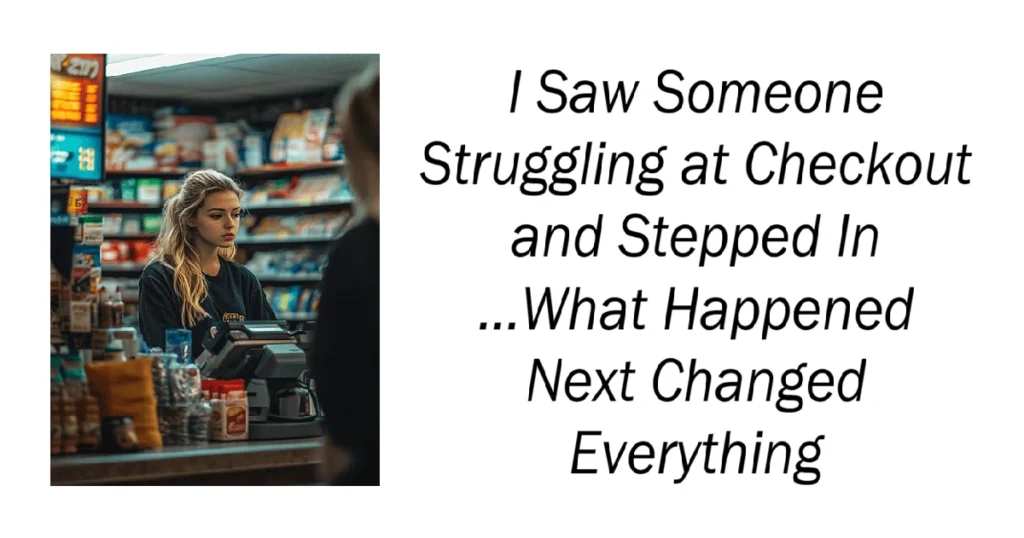
She stood two people ahead of me in line — a young mother, probably in her late twenties. Her coat looked too thin for the cold weather outside. A toddler sat in the cart seat, swinging tiny legs while clutching a box of cereal like it was treasure.
On the conveyor belt sat only essentials: milk, bread, eggs, pasta, apples, and a pack of diapers.
Nothing extra. Nothing unnecessary.
When the cashier finished scanning the items, the total flashed across the screen. I watched her shoulders tighten.
She opened an overused wallet and carefully counted a few bills and coins. Then she counted again. Her breathing grew shallow while the cashier waited with the strained patience that appears when a line starts growing longer.
Finally, she lowered her eyes and whispered, “I’m sorry… can you take the diapers off?”
Her voice cracked ever so slightly.
The toddler smiled up at her, completely unaware of the weight adults sometimes carry in silence.
Something inside me shifted.
Maybe it was empathy. Maybe it was memory. Maybe it was instinct. Whatever it was, I stepped forward before I could overthink it.
“It’s okay,” I said gently. “I’ve got it.”
She turned immediately. “Oh no, I couldn’t—”
“Please,” I insisted. “Let me.”
It wasn’t a dramatic gesture. The remaining balance cost less than I’d spent on takeout the weekend before. I tapped my card before she could protest again.
Her eyes filled with tears.
“You don’t understand,” she whispered. “Thank you. I just… thank you.”
I smiled awkwardly and shrugged. “It’s really no big deal.”
But to her, it was.
And as I would later discover, it would become much more than that to me, too.
The Part I Never Told Anyone
What that woman didn’t know — what nobody in that grocery store knew — was that I had once stood exactly where she was standing.
Ten years earlier, I had been a single parent trying to survive on more stress than income. I remember mentally calculating grocery totals before they even reached the scanner. I remember putting items back. I remember choosing between gas and groceries. Most of all, I remember the quiet humiliation of praying my debit card wouldn’t decline.
One winter evening, it did.
My son was three years old then. I was working two part-time jobs while taking night classes, trying desperately to build a better future for us both.
When my card was declined, I felt my face burn with embarrassment. I started separating items, deciding what we could live without.
That’s when an older man standing behind me stepped forward and said, “Don’t worry about it.”
He paid the balance without hesitation.
No lecture. No pity. No questions.
Just a simple smile and a few words I never forgot:
“We all need a little help sometimes.”
I never saw him again.
But I carried that moment with me for years.
His kindness didn’t just buy groceries. It restored dignity. It reminded me I wasn’t alone. During some of the darkest seasons of my life, that memory stayed with me like a small light refusing to go out.
As life slowly stabilized — as my career improved and survival stopped feeling so fragile — I made a quiet promise to myself:
If I ever had the chance, I would do the same for someone else.
That Tuesday evening in the checkout line, I wasn’t consciously thinking about that promise.
But somewhere deep down, my heart remembered.
The Ripple Effect
After I paid, the young mother hugged me unexpectedly. It wasn’t polished or graceful — just raw gratitude.
As I walked back to my car, I felt lighter somehow.
That’s the strange thing about generosity: we think we’re giving something away, but often we receive far more in return.
For weeks afterward, I thought about her. I wondered if life became easier. I hoped she kept going. I hoped one day she would stand in another checkout line and help someone else the way someone had once helped her.
Then life moved on.
Months passed.
And eventually, the story took a turn I never could have predicted.
When Life Came Full Circle
Nearly a year later, I found myself sitting in a hospital waiting room.
My son — now thirteen — had been injured during a soccer tournament. It wasn’t life-threatening, but it was serious enough to require surgery. Soon, medical bills began arriving faster than insurance approvals.
Financially, I was stable.
But I wasn’t prepared for this.
I spent sleepless nights reviewing statements, arranging payment plans, and trying not to drown in anxiety.
One afternoon, while speaking with someone at the hospital billing counter, I heard a familiar voice behind me.
“It’s you.”
I turned around.
It was her.
The woman from the grocery store.
For a moment, neither of us spoke. Then recognition spread across her face.
“You helped me,” she said softly. “At the grocery store.”
And instantly, I remembered everything — the diapers, the cereal box, the toddler swinging their legs from the cart seat.
She was wearing scrubs.
“I work here now,” she said with a smile. “I finished my nursing program last spring.”
We both laughed in disbelief.
She told me that after that night, something inside her changed. She had been overwhelmed and uncertain whether she could continue pursuing her nursing certification while raising her child alone. But that small moment of kindness had given her hope.
“I don’t know why,” she admitted, “but it made me believe things would be okay.”
Now she worked in pediatric care.
At the very hospital treating my son.
She didn’t pay my bills, and she didn’t need to.
What she gave me was something equally meaningful.
She checked on my son personally. She answered every question patiently. She made sure he felt safe. She even advocated for a billing review that uncovered a coding error — one that significantly reduced our financial burden.
Before leaving that day, she squeezed my hand and smiled.
“You told me it was no big deal,” she said quietly. “But it was.”
And in that moment, I understood something I’ll never forget:
Kindness doesn’t disappear.
The Power of Small Acts
We often underestimate the impact of small gestures.
Psychologists sometimes refer to it as the “ripple effect” — the idea that one act of compassion inspires another, creating waves of goodness that spread far beyond the original moment.
Unexpected kindness reduces stress. It builds trust. It restores people’s faith in one another.
But beyond science, there’s something deeply human about it.
Kindness is an investment made without expecting a return.
And somehow, the return still finds its way back.
Not always from the same person.
Not always in the same form.
But it returns.
Why We Hesitate
If small acts matter so much, why do we hold back?
Because we’re busy.
Because we assume someone else will step in.
Because we worry about overstepping.
Because we fear being taken advantage of.
Because we convince ourselves it’s “not our place.”
But sometimes, it is our place.
Sometimes the difference between despair and relief is simply one person choosing to notice.
And helping someone doesn’t require wealth.
It only requires awareness.
The Quiet Revolution of Compassion
We live in a world flooded with stories about conflict, division, and cruelty. It’s easy to believe kindness no longer matters.
But change doesn’t always begin with grand gestures.
Sometimes it begins in checkout lines.
In waiting rooms.
On sidewalks and parking lots.
A paid balance.
A held door.
A shared umbrella.
A listening ear.
We rarely realize which moments will stay with people forever.
The older man who once paid for my groceries probably forgot me long ago.
But I never forgot him.
And somewhere in the life of that young nurse, a grocery store checkout line will always exist too.
The Lesson I Carry With Me
I don’t think of that night as a story about rescuing someone.
I think of it as honoring the version of myself who once needed help.
And a year later, life reminded me that kindness moves in circles.
It doesn’t vanish into the world unnoticed.
It returns — changed, multiplied, and carried through other people’s lives.
That one small moment didn’t just help a stranger.
It reminded me who I was.
It connected my past to my present.
It brought my life full circle.
If You’re Ever Wondering Whether to Help
Do it.
If you feel the urge to step forward, trust it.
If you notice someone struggling, acknowledge it.
And if you have the ability to lighten someone’s burden — even briefly — never underestimate the power of that moment.
You may never see the outcome.
Or you may.
Either way, you become part of something larger than yourself.
And someday, when you least expect it, you may find yourself carrying a different burden in a different line, only to realize that the kindness you once gave quietly found its way back to you.
Not because the world owes you anything.
But because goodness has a way of remembering where it began.
Sometimes life comes full circle not through dramatic achievements or life-changing milestones, but through small, quiet decisions made in ordinary places.
Like a checkout line on a Tuesday evening.
And sometimes, that’s enough to change everything.